Every quiz · Every flag · Look-alikes
How to memorise every flag
There are 254 of them and 239 you could fairly be asked about. Most people who finish take about two months at ten minutes a day, and almost everybody who fails fails the same way, by looking at flags instead of being asked about them.
The short version
- Be asked. You learn a flag the moment somebody asks and you cannot answer.
- Ten at a time, not fifty. A sitting is about five minutes.
- Start with the ones you already half-know, not with the alphabet.
- Learn the families first, the crosses, the tricolours, the pan-Arab set.
- Then learn the one detail that tells each near-twin from its twin.
- Come back to each flag just before you would have forgotten it.
The rest of this page is those six, with the reason for each and the pages here that do them. There are ten flags to start on at the bottom.
Be asked, not shown
This is the whole thing, and it is the step people skip. Reading a list of flags feels like learning and is not: it builds recognition, which is the feeling of having seen something before, and recognition collapses the moment four names appear under a picture. What you want is recall (pulling the name out of nothing) and the only way to practise pulling something out of nothing is to be asked for it.
It is the best-attested finding in the study of memory, and it has a name.
- The testing effect
The testing effect (also known as retrieval practice, active recall, practice testing, or test-enhanced learning) suggests long-term memory is increased when part of the learning period is devoted to retrieving information from memory.
Testing effect on Wikipedia
Which is why there is no page on this site that shows you flags to study. Every one of them ends in a question: 58 quizzes, a daily board everybody in the world gets the same ten of, and a finder that makes you describe a flag rather than recognise it.
Start where you already are
You are not starting from zero. Most people can already place thirty or forty flags without knowing it, and those are the ones to be asked about first, not because they are worth points, but because a first sitting you get eight out of ten on is a first sitting you come back from. Ten wrong answers on day one is how this ends after day one.
The 239 are cut into five bands here, in the order they are worth meeting. The order is a judgement, roughly how often a flag turns up in front of an English-speaking adult, and the counts are what fell out of it.
- Rank I · The Familiar 40
- Rank II · The Wider World 50
- Rank III · The Deep Field 55
- Rank IV · The Far Corners 54
- Rank V · The Obscura 40
The Familiar: The flags you already half-know. The Obscura: Territories, dependencies, and the famously unguessable. Work down the list, and do not open the last one until the first three are boring.
Learn the families before the flags
Flags are not 239 unrelated pictures. They come in families that share a history, the Nordic crosses, the pan-Arab red-white-black-green, the pan-African red-yellow-green, the Slavic tricolours, the ex-Gran Colombia three, and a family is one thing to learn instead of eight. Learn the family and you have narrowed every flag in it to a shortlist before you have looked at the detail.
There are 13 of these groups written down here, curated by hand rather than measured, because a family is a claim about what people confuse, which is not the same as a claim about what looks alike.
Then learn the one detail
Once you know the families, everything you get wrong is a pair. This is where the second month goes, and it is worth being systematic about: for each pair, find the one difference you can see at a glance and rehearse that, not the two flags.
The two closest flags in the world are Romania's and Chad's. Every flag on this site has been compared with every other one, off the pictures themselves, where two copies of one picture score 0, and that pair comes out at 10.7. The difference is one shade of blue. Both of them, side by side, with the number, and all 254 ranked by how close their nearest neighbour is, which is a fair list of what is going to cost you.
Ask it both ways round
Being able to pick the flag of Peru out of four is not the same as being able to say what the flag of Peru looks like, and neither is the same as being able to spell Kyrgyzstan when you are shown one. They are three different memories of the same fact, and the one you practise is the one you get.
In practice: alternate between naming a flag you are shown and picking a flag from a name, and once a band is going well, make yourself type the answer instead of choosing it. Typing is much harder and worth about three of the others.
Come back just before you forget
A flag you got right this morning will still be there this evening; the useful question is whether it will be there in nine days. It will be if you are asked again at roughly the moment it was about to go, early enough that you still get it, late enough that getting it costs you something. Each time you do, that moment moves further out: a day, then a few days, then a couple of weeks, then months.
- The spacing effect
The spacing effect demonstrates that learning is more effective when study sessions are spaced out.
Spacing effect on Wikipedia
Doing this by hand is genuinely awkward: it means keeping a list of 239 dates, and it is the only part of this method that a piece of paper is bad at. Most people who do it by hand do the cheap version instead: three piles: knew it, nearly and no idea. The third pile every day, the second every few days, the first once a week. That works.
How long it actually takes
24 days to meet all of them once, at ten a day: 239 divided by 10, and the only part of this that is arithmetic rather than a guess.
About two months to keep them, because meeting a flag is not learning it: each one needs to come back a handful of times, spread further and further apart, and the reviews pile up behind the new ones. Ten minutes a day is the honest figure. A weekend of cramming will get you to a very good Saturday and a bad Wednesday.
The last twenty will take as long as the first hundred. Nobody has a handle on the flags of the small Pacific territories, and that is the point at which a mnemonic is worth inventing, one silly sentence per flag, for twenty flags. Inventing 239 of them is a second thing to memorise.
What does not work
A poster on the wall. You will learn to recognise the poster. Cover the names and you will find out how little of it went in.
Going continent by continent, only. It is a reasonable way to cut the work up, and it hides the thing that actually catches you out: the flags people confuse are hardly ever neighbours. Chad is in Africa and Romania is in Europe.
Learning names and flags at the same time. If you cannot place the country on a map, learn the flag first and the geography later. Two unknowns at once is how a session stops being fun.
Any method you do not do. Ten minutes a day beats an hour a fortnight by a distance that is not close, and it is the same finding as the one about spacing above.
Where this page came from, and what Flagory adds
This page was written once, and then left alone. That is worth saying, because almost everything else here is put together by a program out of public sources, the colours are measured off the artwork, the symbols are quoted from the article that describes them, the differences are recomputed on every build. None of this page is, which is why the two claims on it that are not about flags carry the sentence they rest on and a link to it.
Everything above can be done on this site, free, with no account: the quizzes, the daily board, the look-alike groups and the measured differences are all a click away and none of them asks you for anything.
Flagory (the app this site belongs to) is the same method with the sixth step done for you. It keeps which flags you got wrong and when, works out the day each one is about to go, and puts that flag in front of you on that day. It also asks in six different ways rather than one. It is not a different method; it is this one, with the list of 239 dates kept by something that does not mind keeping it.
Now do ten
The Familiar, The flags you already half-know. Nothing is stored, nothing is sent, and there is no account to make.
The same ten the page plays, written out. Each flag's answer is under the line below it.

The answer
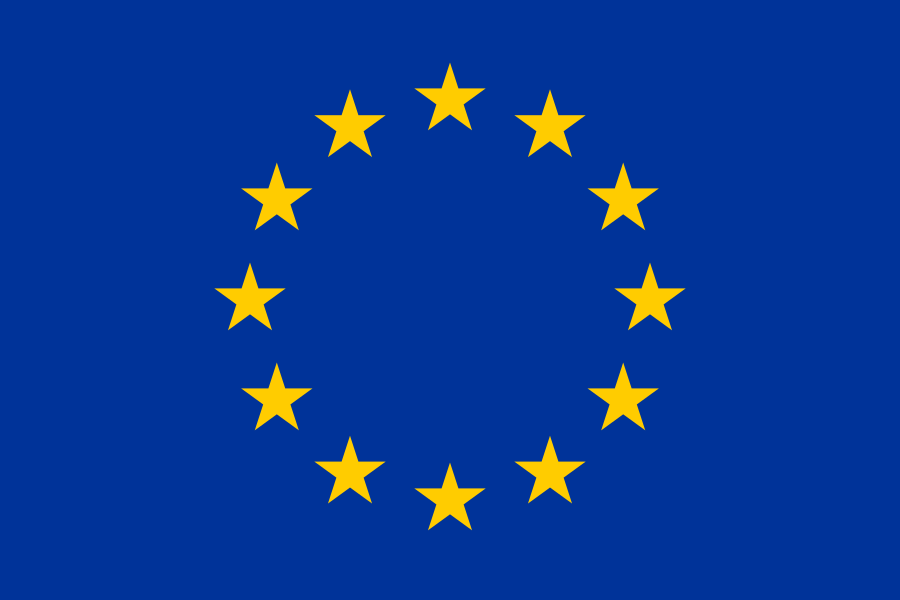
The answer

The answer

The answer

The answer

The answer

The answer
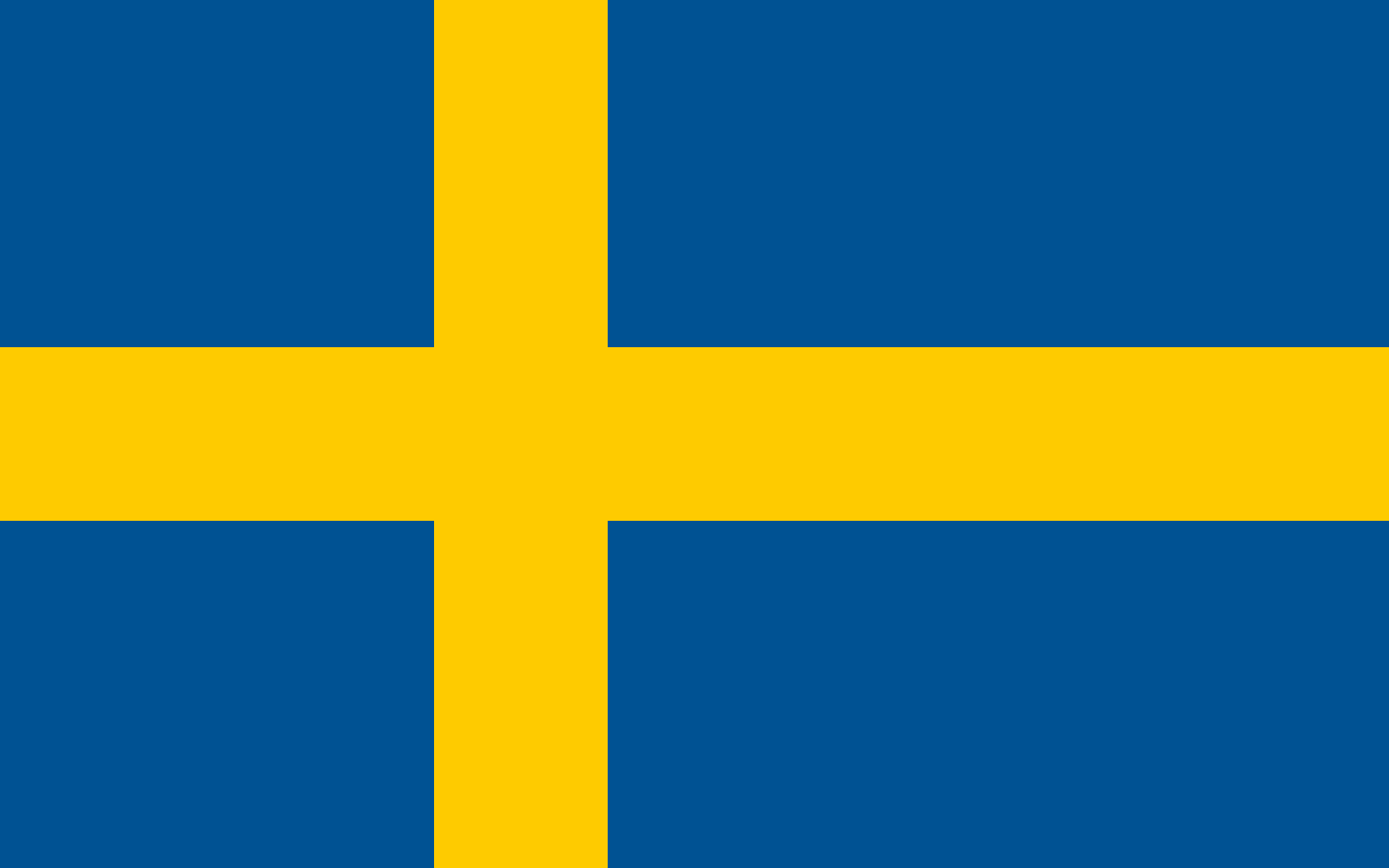
The answer
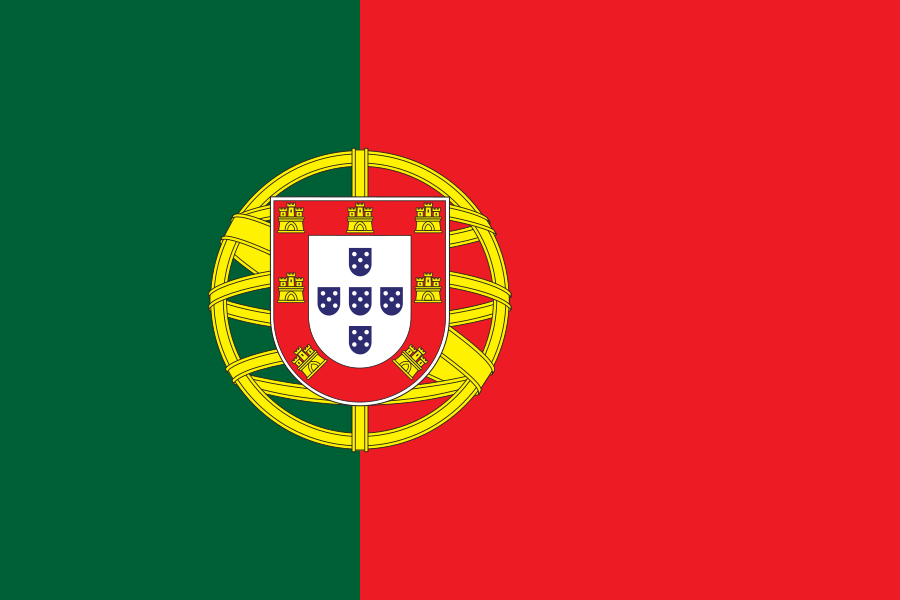
The answer

The answer
And when these are easy, the rest of the band is at Rank I · The Familiar.