Colours
Read from the flag itself, down to the exact shade.
- #3e9a00
- #e32118
- #ffffff
- #0073ce
How it is put together
Measured off the picture, the same way the colours were, not from anybody's description of it.
- 3 horizontal bands
The fly edge changes colour going down, the foot does not, and every change is a straight line right across.
- a triangle at the pole
A wedge whose base is the whole pole edge, widest halfway down, in a colour the fly side is not painted in.
What is on it
Each of these is what this flag's own Wikipedia article says is on it, the sentence is underneath, so you can see what it rests on.
- star
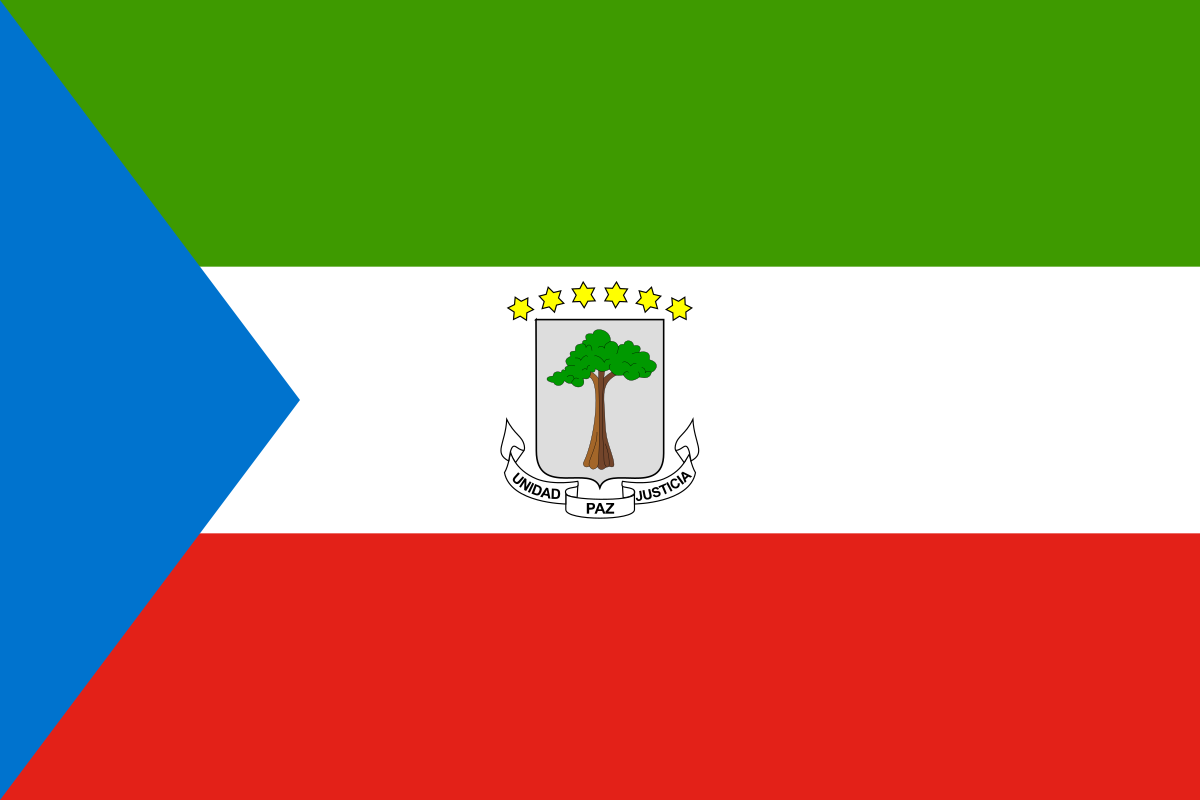
The white band is charged in the center with the coat of arms of Equatorial Guinea, a grey shield with a silk-cotton tree, the national motto in Spanish, and six six-pointed stars representing the country's five islands and continental territory.
Flag of Equatorial Guinea on Wikipedia
- coat of arms
The national flag of Equatorial Guinea is a horizontal tricolour of green, white, and red with a blue isosceles triangle based at the hoist and the coat of arms of Equatorial Guinea centered on the white band.
Flag of Equatorial Guinea on Wikipedia
- writing
The white band is charged in the center with the coat of arms of Equatorial Guinea, a grey shield with a silk-cotton tree, the national motto in Spanish, and six six-pointed stars representing the country's five islands and continental territory.
Flag of Equatorial Guinea on Wikipedia
- shield
The white band is charged in the center with the coat of arms of Equatorial Guinea, a grey shield with a silk-cotton tree, the national motto in Spanish, and six six-pointed stars representing the country's five islands and continental territory.
Flag of Equatorial Guinea on Wikipedia
- tree
The white band is charged in the center with the coat of arms of Equatorial Guinea, a grey shield with a silk-cotton tree, the national motto in Spanish, and six six-pointed stars representing the country's five islands and continental territory.
Flag of Equatorial Guinea on Wikipedia
What we know about it
The flag without the coat of arms was raised at independence from Spain on 12 October 1968; the arms were added later, and both were briefly changed between 1978 and 21 August 1979, under Francisco Macías Nguema, who was overthrown by his nephew Teodoro Obiang Nguema Mbasogo on that date. The shield carries a silk-cotton tree (local legend has indigenous and Spanish representatives signing their first treaty under one) and six stars for the country's five islands and continental territory. Whitney Smith read the blue triangle as the ocean connecting the parts of the country, green as its vegetation, white as peace and red as the blood shed for independence.
Drafted from Flag of Equatorial Guinea on Wikipedia, as it read on 2026-08-26, and checked back against it: every date, name and number above appears in the sentences it was written from. Nobody here wrote it by hand.
Its days
The almanac keeps a page per day of the year that something is dated to. This flag is on 2 of them, with the sentence that says so.
Nearest in the world
Every flag is compared with every other one, off the pictures themselves. Two copies of one picture score 0; these are the closest to this one. How that is measured.
Quiz yourself
Ten questions, played on the page, no sign-up and nothing kept. Equatorial Guinea is one of the flags in each of these.
The picture
- Licence
- Public domain
- Drawn at
- 1200 × 800
Credit See File history below for details.
From Flag of Equatorial Guinea.svg on Wikimedia Commons.

Take the picture, as a drawing or as an image, with the licence and the credit above attached to it.